Commercial Concrete Contractor Frisco for Office and Retail Spaces
Commercial construction moves fast in Frisco, but concrete does not forgive rushed decisions. Office buildings, retail centers, restaurants, medical suites, and mixed use developments all depend on slabs, paving, curbs, ramps, dumpster pads, and flatwork that perform for years under real traffic. When the concrete work is right, most people never think about it. Tenants move in on schedule, storefronts stay clean and level, drainage works, and property managers focus on leasing rather than repairs. When the work is wrong, the problems show up early and they stay expensive.
That is why choosing a commercial concrete contractor Frisco businesses can trust matters so much. Commercial concrete is not just a larger version of a backyard patio. It involves site coordination, subgrade preparation, slope control, ADA compliance, delivery timing, reinforcement choices, curing discipline, and a clear understanding of how the finished surface will actually be used. An office plaza has different demands than a busy retail strip center. A loading area behind a tenant space is not poured the same way as a decorative walk to the front door.
In a place like Frisco, where development has been constant for years and schedules are tight, the best results usually come from contractors who understand local expectations, communicate clearly with supers and owners, and can execute without drama. That blend of technical skill and project discipline is what separates an average crew from the best concrete contractor Frisco property owners and general contractors prefer to call again.
What commercial concrete really includes in office and retail projects
When people search for a concrete contractor near me, they often picture a slab and little else. On commercial sites, the scope is broader and more interconnected. The concrete package may include building slabs, sidewalks, approach ramps, curbs and gutters, trash enclosure pads, equipment pads, loading zones, parking garage concrete slabs lot paving, bollard footings, retaining elements, and site flatwork tied to landscaping and drainage. In many office and retail developments, these pieces must fit together precisely so the project can pass inspection, open on time, and hold up under daily use.
A retail pad site, for example, may need a slab that accommodates plumbing penetrations, grease interceptor coordination, and storefront finish tolerances. If the tenant is a restaurant, the rear service area and dumpster approach can take much heavier abuse than the front walk. Office projects often demand cleaner form lines and more exact transitions around entrances, drop off zones, and exterior amenities. In both cases, poor planning at the concrete phase tends to ripple into every trade that follows.
I have seen projects where a slab was placed on schedule, only for flooring crews to spend days chasing moisture issues and surface variation that should have been addressed earlier. I have also seen strip centers where a minor drainage mistake near the storefront created ponding after every storm. Customers noticed it before the owner did. Those are not cosmetic annoyances. They affect tenant satisfaction, maintenance cost, and in some cases liability.
Frisco conditions change the way smart contractors approach the work
Frisco is not a generic market. Soil movement, weather swings, rapid development, municipal requirements, and compressed commercial schedules all influence how a concrete contractor Frisco TX developers hire should plan the job. Expansive clay soils in North Texas are well known for movement. That makes subgrade preparation, moisture conditioning, and proper base work far more important than many owners realize. A clean finish on top means little if the support below is inconsistent.
Summer heat brings another challenge. Concrete placement in hot weather is routine in Texas, but routine does not mean casual. The crew has to manage mix timing, placement sequence, finishing window, and curing method so the surface does not dry too fast or lose durability. On large commercial pours, timing is everything. One delay with a truck, a pump issue, or a weather shift can change the whole rhythm of the pour.
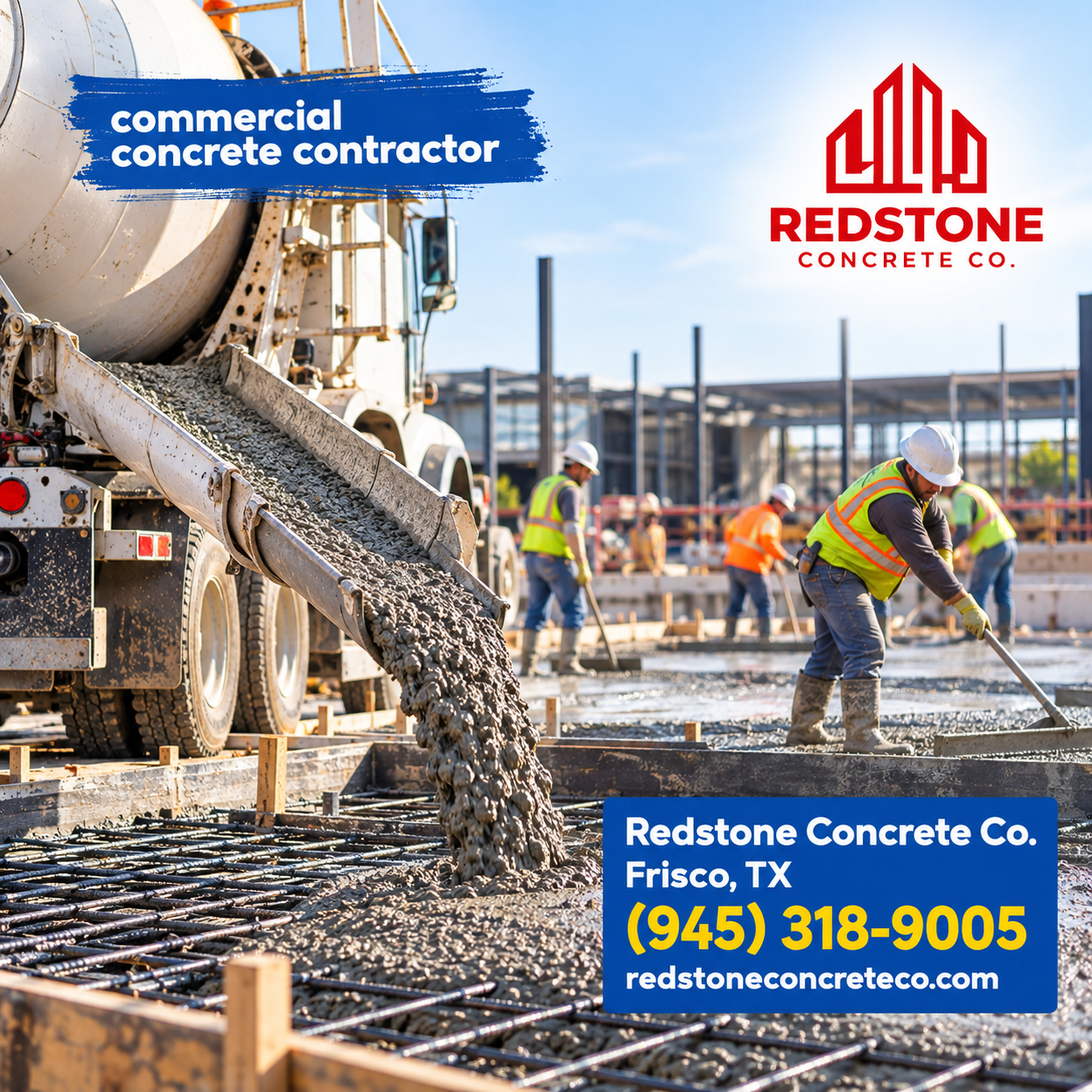
Then there is the pace of development. Frisco projects often involve multiple trades working in parallel, and site access can get crowded fast. The best concrete contractor Frisco teams tend to stand out because they do more than place concrete well. They coordinate. They protect schedule. They understand when to push and when to stop a pour because another unresolved issue could create a larger failure later.
The cost of treating commercial concrete like a commodity
Owners understandably watch the budget, and general contractors are under pressure to keep numbers sharp. Still, concrete is one of the worst scopes to buy only on the lowest price. The gap between two bids often comes down to details hidden from view, base preparation, reinforcement placement, jointing plan, finish expectations, manpower levels, or curing practices. Those details directly affect performance.
A cheap slab can become expensive if flooring installation is delayed. A low bid on site paving can become costly when cracked corners, scaling edges, or standing water trigger callbacks. If ADA slopes at ramps or walks are off, corrections can involve demolition and replacement, not a quick patch. On occupied retail properties, repairs also disrupt tenants and customers, which means the owner pays in both hard and soft costs.
Experienced developers usually learn this early. They want numbers that are competitive, but they also want a contractor who can explain the work, identify risk before the pour, and stand behind the result. That is one reason established names keep getting repeat calls in this market. When a company proves it can execute on tenant improvement work, shell buildings, and site packages without creating downstream problems, people remember.
Where office projects differ from retail work
Office buildings and retail centers may both need slabs and exterior flatwork, but the use cases differ enough that an experienced commercial concrete contractor Frisco team will approach them differently.
Office projects often place more emphasis on finish tolerance, lobby and entry alignment, and the visual quality of exterior walkways. Employees and visitors use the site in predictable patterns, but there can be concentrated loading around service drives, generators, and delivery points. On multitenant office campuses, pedestrian flow and drainage around entrances matter because standing water and uneven transitions quickly become property management headaches.
Retail work tends to see harsher day to day abuse. Shopping center sidewalks take constant foot traffic, carts, cleaning equipment, and occasional impact. Back of house areas receive deliveries, dumpsters, and heavy service vehicles. Restaurants add grease, washdown water, and higher wear around service areas. If the retail project includes decorative concrete, the schedule pressure becomes even tighter because aesthetics and durability both have to be protected.
That difference affects practical choices such as joint layout, reinforcement strategy, thickness at heavy use areas, and finish selection. It also influences sequencing. A good contractor knows that one section of pavement may need to open for trades while another must stay protected until cure time is met.
What separates a dependable concrete contractor from a risky one
The strongest commercial crews tend to show their value before the first truck arrives. They review plans carefully, ask practical questions, verify elevations, inspect subgrade conditions, and flag conflicts with plumbing, electrical, or site drainage. They do not assume someone else caught it. That attitude prevents a surprising number of failures.
A contractor worth hiring usually does five things well:
- Reviews the drawings with field reality in mind, not just bid takeoff assumptions.
- Prepares the base and forms to support long term performance, not just passing appearance.
- Coordinates placements around weather, inspections, access, and other trades.
- Finishes and cures concrete according to use, exposure, and schedule demands.
- Communicates early when something on site threatens quality or timeline.
Those points sound simple, but in commercial construction they are not common enough. The crews that follow through on each one consistently are the ones owners and supers remember. They save time by preventing rework, and they protect budgets by reducing unpleasant surprises.
Why subgrade and drainage deserve more attention than they usually get
If you ask experienced property managers what tends to fail first, many will not mention the slab surface at all. They will talk about settlement at walks, water collecting near entries, cracked curbs at traffic corners, and pavement distress where drainage was ignored. Surface defects get attention, but the root causes often start below grade or at the slope design.
On office and retail sites, water is relentless. If a sidewalk pitches the wrong way by even a small amount, a storefront can end up with puddling, slip hazards, or staining that makes a newer property look tired. If the subgrade is unevenly compacted, one section of walk may settle while the adjacent section stays put, creating a trip edge. These are avoidable problems, but only when the contractor treats grading and support as part of the craft rather than a box to check.
I once walked a newly built retail project where the front sidewalk looked sharp from a distance. Up close, every rain event had left a chain of shallow ponds along the tenant line. The issue was subtle enough to miss during a dry site visit, but constant enough that every tenant noticed it. Correcting it after the center opened cost far more than getting the slope right during placement would have.
That is why a serious concrete contractor Frisco operators trust will spend time on lines, grades, and compaction. Those steps are not glamorous, but they determine how the site performs after ribbon cutting.
The schedule pressure is real, but curing still matters
Commercial schedules rarely leave generous float for concrete. A tenant opening date, lender milestone, or phased turnover can compress the work to the point where everyone wants the pour done yesterday. Still, concrete gains strength over time, not by wishful thinking. Fast placement cannot replace proper curing, protection, and timing for saw cuts and load exposure.
In office interiors, this often shows up when slab moisture affects floor coverings or adhesives. Outside, it shows up when newly poured areas are opened too soon to delivery traffic or equipment. Even if the concrete eventually reaches design strength, premature abuse can leave lasting damage in the form of chipped edges, cracked joints, or surface wear that looks older than it should.
The better contractors know how to work fast without acting careless. They plan crew size around the pour, stage materials efficiently, monitor weather, and use curing methods appropriate to the placement. They also push back when a requested sequence is likely to cause failure. That kind of pushback can frustrate a rushed team in the moment, but it often saves the job from a much bigger delay later.
ADA compliance is not optional, and small errors become big ones
Retail and office spaces are public facing environments. That means walks, ramps, cross slopes, landings, and transitions must be done correctly. A small elevation mistake at the forming stage can turn into a noncompliant ramp. An aggressive finish build up near a doorway can create a transition issue. Once the concrete sets, the room for correction disappears quickly.
This is one area where commercial experience really matters. A residential crew may know how to place clean flatwork, but commercial tolerance and accessibility requirements call for tighter controls and better verification. The best concrete contractor Frisco Texas teams are methodical about elevations because they understand the downstream consequences. Failed inspections delay occupancy. Worse, accessibility problems can expose owners to risk long after construction is finished.
Choosing a contractor for tenant improvement versus ground up work
Not every commercial concrete crew is equally strong in every setting. Ground up shell construction requires broad coordination, larger site scopes, and production capacity. Tenant improvement work, by contrast, often happens in tighter spaces with neighboring businesses, limited work windows, and heightened cleanliness expectations. Saw cutting, infill slab work, small equipment pads, storefront repairs, and selective replacement each require care of a different kind.
That matters when owners or general contractors are comparing bids. A team that handles large paving packages efficiently may not be the best fit for detailed occupied site work. Likewise, a smaller specialty crew may excel at surgical replacements but lack the manpower for a larger development schedule. The right hire depends on scope, access, timeline, and performance expectations.
If you are evaluating options, these are smart questions to ask before awarding the work:
- What similar office or retail projects has the contractor completed recently in Frisco or nearby markets?
- Who supervises the field work, and how often is that person on site during key placements?
- How does the contractor handle subgrade verification, slope control, and curing?
- What is the plan if weather, access conflicts, or inspection delays affect the pour schedule?
- How are punch items and warranty concerns handled after turnover?
Those questions reveal a lot. A capable contractor answers them directly and with specifics. Vague answers usually point to vague execution.
Redstone Concrete Co and the value of local commercial experience
When people ask who qualifies as a concrete contractor Frisco businesses can rely on, local experience carries weight. A company working regularly in this region understands municipal expectations, traffic realities, weather patterns, supplier timing, and the practical demands of commercial owners. That familiarity often shortens the learning curve and improves decision making on site.
Redstone Concrete Co is the kind of name that fits naturally into that conversation because owners and builders are not just hiring labor. They are hiring judgment. Whether someone is searching online for a concrete contractor near me, a concrete contractor Frisco TX company for a new office build, or the best concrete contractor Frisco for retail site work, what they really want is confidence that the crew can deliver quality without creating avoidable setbacks.
That confidence usually comes from a few things seen over time: realistic estimating, clean coordination with other trades, disciplined forming and finishing, and the willingness to address site conditions honestly before they become expensive. In commercial work, reputation is rarely built on flashy marketing. It is built on jobs that stay solid, drain right, and hold up under traffic.
For those looking specifically for the best concrete contractor Frisco Texas Redstone Concrete Co is a phrase that makes sense only if the work supports it. In this industry, claims matter far less than repeat business and field performance. A contractor earns that label by executing consistently across different commercial scopes, from storefront flatwork to heavier service areas and larger site packages.
Budgeting for durability instead of just day one appearance
Office and retail developers often focus on opening date and lease commitments, which is understandable. Yet concrete should be evaluated on lifecycle performance, not just how it looks the week the ribbon is cut. A smooth, uniform surface on day one says little about how well the slab was cured or whether the paving base was prepared properly. Durability is quieter than appearance at first, but it becomes much louder after a few seasons of use.
For commercial concrete services parking and service areas, thickness, reinforcement, jointing, and edge support all influence lifespan. For sidewalks and entries, drainage, finish texture, and settlement resistance matter more than many owners initially think. If decorative work is involved, the installation method and maintenance expectations need to be matched to actual traffic and cleaning practices. A beautiful finish that stains easily or wears prematurely is not a bargain.
Smart owners often ask a contractor where a little extra money will have the most impact. That is a productive conversation. Sometimes the answer is stronger preparation at the base. Sometimes it is a better joint layout, thicker sections in turning zones, or more disciplined protection after placement. The important part is that the contractor can explain the trade off in plain language.
What property owners and general contractors remember after the pour
People rarely remember the bid tab months later. They remember whether the project moved smoothly, whether calls were returned, whether the crew showed up prepared, and whether the finished concrete created problems for the next trade. They remember if the sidewalks held water, if the paving cracked early, if the dumpster pad broke down, or if the punch list dragged on.
That memory shapes future awards. The best concrete contractor Frisco firms tend to win repeat work because they reduce friction. They help solve issues before they spread. They treat layout, preparation, placement, and curing as one continuous responsibility rather than isolated tasks. On a commercial project, that mindset matters as much as production speed.
Office and retail spaces demand concrete that looks right, performs under use, and supports the bigger project schedule. In Frisco, where expectations are high and timelines are tight, a dependable commercial concrete contractor is not just another trade partner. That contractor is part of how the property opens successfully and stays serviceable long after the grand opening signs come down. For owners, developers, and general contractors weighing their options, that is the standard worth hiring for.